“I know.”
It’s a simple sentence.
Two words.
Yet I believe they’re among the most dangerous words a designer can say.
Not because knowledge is bad.
Knowledge is valuable.
Experience is valuable.
Confidence is valuable.
The danger begins when those words quietly become the end of a conversation instead of the beginning of one.
I’ve been designing for over ten years now.
There are problems I’ve solved dozens of times.
Patterns I’ve seen repeatedly.
Mistakes I can spot almost instantly.
It’s tempting to believe experience gives you the right answer before the conversation has even started.
Sometimes it does.
Many times, it doesn’t.
That’s the trap.
Experience doesn’t just give us wisdom.
It also gives us assumptions.
And assumptions are invisible.
They’re the hardest things to question because they feel like facts.
One of the things I enjoy most is discussing ideas with junior designers and interns.
Not because they have less experience.
But because they have fewer assumptions.
They ask questions that experienced designers often stop asking.
“Why do we do it this way?”
“Who decided this?”
“What if we tried something completely different?”
Those questions are powerful.
Not because they’re always right.
But because they force the rest of us to think again.
I’ve noticed something interesting over the years.
The designers I admire the most aren’t the ones with all the answers.
They’re the ones who stay genuinely curious, even after years in the industry.
They still ask.
They still observe.
They still change their minds.
Somewhere along the way, many of us confuse confidence with certainty.
Confidence says,
“I’ve seen this before.”
Certainty says,
“So there’s nothing new to learn.”
Only one of those leaves room for growth.
Design has never been about being right.
It’s about getting closer to the right answer.
That journey demands something experience alone can’t provide.
Humility.
Every user interview reminds us that people don’t always behave the way we expect.
Every usability test exposes assumptions we didn’t realize we had.
Every developer brings technical perspectives we hadn’t considered.
Every client understands parts of the business we’ll never know as deeply as they do.
Every teammate notices something we’ve missed.
The best ideas rarely belong to one person.
They’re built from many perspectives coming together.
That’s why I try to replace one sentence in my own mind.
Instead of saying,
“I already know.”
I try to ask,
“What am I missing?”
That single question has changed more of my designs than any design tool, framework, or trend ever has.
Maybe that’s what experience should really give us.
Not bigger egos.
Better questions.
Because the day we stop asking questions isn’t the day we become experts.
It’s the day we stop growing.
And for someone whose job is to solve problems for people, that’s a dangerous place to be.
So if there’s one habit I hope I never lose, it’s this:
To remain a student.
Not because I don’t have experience.
But because experience has taught me that the world always has one more lesson waiting for those willing to listen.
A subtle pixel to leave you with:
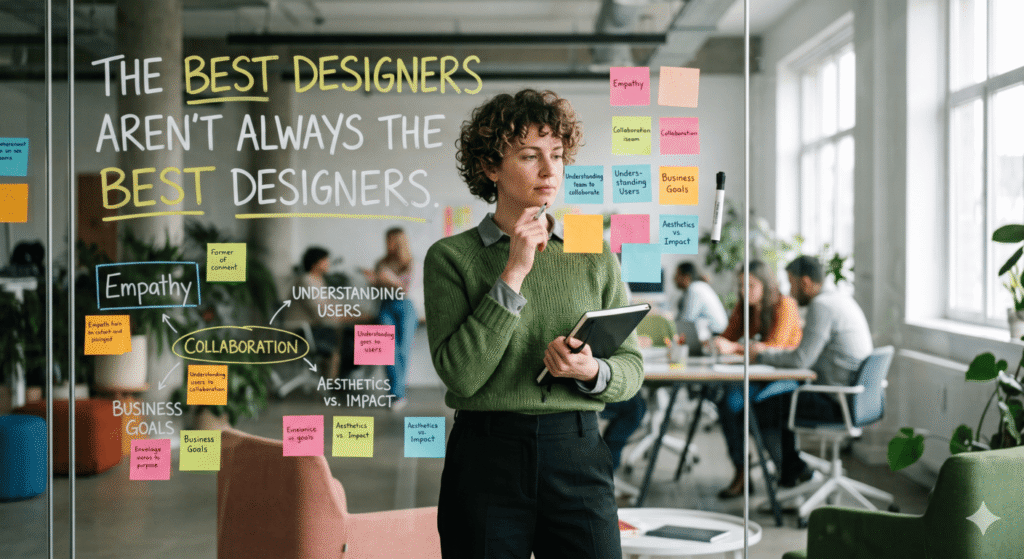
The best designers aren’t the ones with the most answers. They’re the ones who never stop asking better questions.