

AI product · Family tech · Concept project

An AI assistant that does the remembering for the whole family

A venture concept of my own: an AI assistant for the home. It gathers what arrives in email, calendars, WhatsApp and messages, turns it into a plan, tracks each family member’s health and medicines, suggests meals and orders the missing groceries, all with the family’s consent. You open it to a living orb and tell it by voice or text.

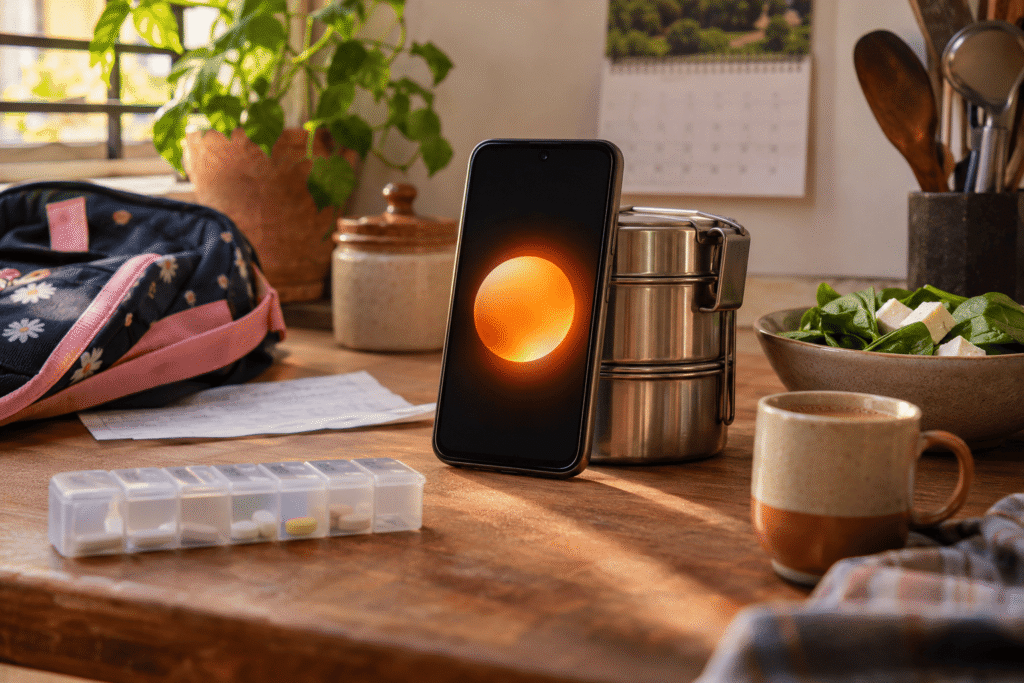
AI-generated image of an Indian family’s morning in a Bengaluru kitchen, with a phone showing a glowing orange orb.
Role
Founder and product designer
Timeline
In progress
Platform
iOS and Android app
Status
Published

At a glance

The problem

In most homes one person carries the remembering: the school notice, the fee, a parent’s medicine, what to cook. The information is scattered across email, WhatsApp, messages and calendars, and no tool connects it into a plan.

What I designed

Hemma is an AI assistant for the home. It collects from email, calendars, WhatsApp and messages, and from what you tell it by voice or text, then plans, reminds the right person and, with consent, orders groceries and medicines.

The evidence behind it

Published research on the mental load, a review of four family products, a check of the shopping platforms, and four family scenarios designed end to end.

My role

Founder and product designer: research, thesis, product definition and app design.

Three decisions that shaped it

  1. 01The assistant is the app: an orb you talk to, not a menu of lists
  2. 02It proposes and asks, and money or messages to others always need a yes
  3. 03Health, medicines and meals belong to a named person, and the caregiver receives the reminders

How I know it works

Items captured that become an approved plan, per household each week

01

The brief

A venture concept of my own. Families have plenty of calendars and to-do apps, yet someone still has to notice how everything connects and decide what the household needs today. I wanted to design an assistant that does that noticing and planning, and earns a family’s trust while it does.

What it is
A concept for an AI home assistant app on iOS and Android, designed as my own startup idea.
My role
Founder and product designer: research, thesis, product definition and app design.
The family it is built around
Six people: Meera, who coordinates the home, her husband Karan, their children Aarav and Diya, and Meera’s parents Lata and Prakash. The names are placeholders.
This case study
The problem, the landscape, the product definition and four scenarios: school notices, health and meals, medicines, and family events.

02

The remembering is the work

Research on the mental load shows who carries the thinking work of family life, and how much of it there is.

71%

of household mental-load tasks handled by mothers

Fathers handled 45%. A study of 3,000 US parents on the thinking work of scheduling, planning and organising.

Source: University of Bath and University of Melbourne, 2024 ↗

30.4 hrs

a week parents estimate they spend on family scheduling and planning

A survey of more than 2,000 parents. The time is self-reported.

Source: Skylight and The Harris Poll ↗

400M

monthly WhatsApp users in India in 2019

India was already the app’s largest market, so it is where family news arrives and where a reminder will be seen.

Source: TechCrunch, 2019 ↗

  • The same Bath and Melbourne study found mothers take on 79% of daily jobs like cleaning and childcare, fathers 37%
  • School information lives in email, paper and chat, plans live in calendars, and the connections live in someone’s head

03

What already exists

I reviewed four products families can use today, and the habits they replace. Each is good at showing the family what is happening. Most want the family to hand over one event at a time.

Each dot is a product. Left to right shows how information gets in. Bottom to top shows how much it connects the pieces. The green corner is the space nobody covers.

a calendar or lista connected household

Connects the pieces, but you feed it

Reads what arrives and connects the pieces

A calendar you fill in

Reads what arrives, but stops at the calendar

Cozi
Skylight
Ohai
Ario
Hemma
← you type it init reads what arrives →
  • An existing option
  • This product
Placement comes from my review of each product’s published features and entry points, set against the same two questions.

Family organisers

  • Cozi
  • Skylight

Shared calendars and lists, one on the phone and one on a 15 inch wall screen. Both now import events from email, PDFs and flyer photos on a paid plan, but the calendar stays the centre.

AI assistants for parents

  • Ario
  • Ohai

Ario raised a $16 million seed round in 2024 and adds a school schedule to the calendar from a photo. Ohai raised $6 million and works through a text thread. Both are early and US-first.

What families already use

  • WhatsApp
  • Email
  • SMS
  • Google Calendar

This is where school notices, bills and plans really arrive. It works because it is already open, and fails because nothing links one message to the next.

The gap I saw

  • Most of the products I reviewed take one event at a time that you hand them. Reading the household’s own sources, with consent, and remembering them is where I saw room.
  • Most stop at the calendar. The fee, the costume, the medicine and the dinner around an event are still left to a person to notice.
  • None of the four that I reviewed looks after each family member’s health and medicines, or carries the plan through to a delivered order.

04

What the platforms offer

An assistant that reads and orders only works if the platforms let it. I checked both before designing the product around them.

20 tools

in Swiggy’s Instamart MCP, covering product search, cart, coupons, payment status, ordering and live tracking

It is open to developers, startups and enterprises through Swiggy’s Builders Club, which makes Instamart the first route for placing a grocery order for a family. Blinkit and Zepto are partnership conversations.

Source: Swiggy Builders Club ↗

SMS

Google Play limits SMS permissions to default handlers and approved exceptions

So messages reach Hemma through connected accounts, forwarding and share-in first, with deeper reading decided per platform.

Source: Google Play policy ↗

iOS

Apple developer support says an iOS app cannot fetch SMS and iMessage conversations

Connected email and calendars, and share-to-app, work on both platforms with the family’s consent, which is why they carry the first version.

Source: Apple Developer Forums ↗

  • Pharmacy delivery apps such as PharmEasy and 1mg are the route for medicine orders
  • Payment uses the family’s saved UPI or cards, after they agree to the order

05

How I worked

Four pieces of work, each one feeding the next: what is known, what I believe, what is possible, and what the product does.

  1. 01

    Research brief

    Market, competitors, personas, architecture, risks and privacy law, written down with sources.

  2. 02

    Competitor and platform review

    Four family products, and what the messaging and quick-commerce platforms allow, so the design starts from what is possible.

  3. 03

    Thesis and product spec

    One sentence on the real problem, the cast of six, four scenarios, a consent model and the scope of a first version.

  4. 04

    App design

    The orb home, voice and text capture, the plan, the family profiles, the ordering and medicine flows, and a design system, in Light and Dark.

06

How a school notice moves today

The signature scenario I designed around. A notice arrives, and everything after that depends on one person remembering.

  1. 01

    The notice arrives

    A paper circular, a photo in a WhatsApp group, an SMS or an email: Annual Day on Thursday at 5:30 PM, costume required, a ₹500 fee due Monday.

  2. 02

    One parent reads it

    Usually the same parent each time. The details live in their head from that moment.

  3. 03

    Some of it is typed in

    Maybe the event goes into a calendar. The fee, the costume and the shopping rarely do.

  4. 04

    Others find out late

    The other parent learns by asking, or not at all, and may already have a meeting that evening.

  5. 05

    The rush happens

    The fee is remembered late and a costume is assembled the night before.

07

What goes wrong at home today

The same few problems sit under every dropped ball.

  1. 01

    Someone has to notice

    A calendar says when. It does not say what the event means for the household. A person is the only link between the pieces.

  2. 02

    Everything lives somewhere else

    Plans in calendars, chatter in WhatsApp, bills in SMS, prescriptions on paper, groceries in shopping apps.

  3. 03

    The load is invisible

    The work is continuous and it disappears when it is done, so nobody sees it and it is rarely shared.

  4. 04

    Medicines are easy to lose track of

    Several people, several prescriptions, different doses and refill dates. A parent’s tablets running out is a problem nobody notices until it happens.

  5. 05

    What to cook today

    Someone decides every day what the family eats, around everyone’s health, tastes and what is in the kitchen. It is a small decision that repeats, and it is never off the list.

  6. 06

    Silent automation feels risky

    Families will not hand over school, money, health and children’s data to something that acts without asking.

08

One home, six people

A household is not one user. Hemma serves all six people through the one who coordinates, and each role carries a hypothesis the next round of research tests.

M

Meera

The coordinator

Carries most of the remembering today, for the children, the husband and Meera’s own parents. The one who sets Hemma up, tells it things and approves what it proposes.

Hypothesis. If what arrives becomes a plan they only have to confirm, they will keep it switched on.

K

Karan

The husband

Wants to see which actions are his, where he needs to be and what to pick up, without reading the whole picture.

Hypothesis. If assigned actions arrive with a reason, he will take them on instead of having to be asked.

A

Aarav and Diya

The children

School notices, events, packing lists, meals and health needs. Meera and Karan decide what they see, and Hemma keeps their health details private to the adults.

Hypothesis. If the school plan reaches Meera before the deadline, fewer things are forgotten at the door.

L

Lata and Prakash

Meera’s parents

Regular medicines, appointments and meals that suit their health. Meera looks after them, so their reminders come to Meera rather than to them.

Hypothesis. If Meera sees every dose and refill in one place, a missed tablet or an empty strip is caught early.

09

Hypotheses to validate

The questions I put to families next, each with a clear way to test it.

  1. 01

    Will families grant access

    Will they connect email and calendars, and which message sources would they refuse? Test: a prototype of the permission flow, with interviews on what they would share.

  2. 02

    Is approving a plan welcome or a chore

    Does confirming a proposed plan feel like help or like extra work? Test: a prototype of the approval step with real notices.

  3. 03

    Will they let it order and pay

    Will a family approve a cart and let the assistant pay on their saved UPI or card? Test: a prototype of the order approval, with interviews on trust and limits.

  4. 04

    How accurate is reading

    How well are dates, fees and requirements read from real notices, and drugs, doses and frequency from real prescriptions and pharmacy invoices? Test: a set of real documents run through the extraction.

10

Design principles

Six rules I set before drawing any screen. Each one answers something that would break trust.

  1. 01

    The agent is the app

    You open Hemma and talk to it. There is no menu of features to learn first.

  2. 02

    Reading is a permission, not a default

    Every source is switched on by the family, shown clearly, and can be turned off and deleted at any time.

  3. 03

    Plans, not notifications

    Everything it captures ends in a decision or an action for a named person.

  4. 04

    Ask before it acts

    It suggests, the family approves, then it acts. Spending money and messaging other people always need a clear yes.

  5. 05

    Per person, not per household

    Health and medicines belong to a named person, with their own privacy setting.

  6. 06

    Suggestions, not medical advice

    Meals and reminders support the family. They never diagnose or replace a doctor.

11

The calls I made

Seven decisions shaped the product. Each one comes from a problem that would cost a family’s trust, or from a limit I found.

01

What the app is

Options I weighed

  • A calendar and lists with an assistant tab
  • ✓An assistant you open to and talk to, with the plan behind it

Why

The hard part of a household is deciding what matters now. An orb that listens by voice or text puts that question first.


02

How it learns about the household

Options I weighed

  • The family types everything in
  • ✓Connected sources, voice and text, plus documents and photos

Why

The notice already arrives somewhere. Reading it, with a permission the family can withdraw, saves the typing that makes other tools fall out of use.

03

How it acts

Options I weighed

  • Automate quietly
  • ✓Propose a plan and act only after a yes

Why

A wrong date or a wrong order costs trust fast. Showing the plan keeps the family in charge.

04

How groceries work

Options I weighed

  • Hand the family a shopping list
  • ✓Infer what is at home, ask, recommend what is missing, then order and pay after a yes

Why

The list is not the job, the dinner is. Hemma starts from past orders, asks about what it cannot know, and orders on the family’s saved UPI or card after a yes. Instamart is the first route, and Blinkit and Zepto are partnership conversations.

05

Who gets the medicine reminders

Options I weighed

  • Each person for themselves
  • ✓The caregiver, Meera, for Lata and Prakash

Why

Meera looks after Lata and Prakash. A missed tablet is the failure to design against, so the reminder goes to the person who will act on it.

06

Where health information comes from

Options I weighed

  • Wearables first
  • ✓Manual entry and uploaded documents first, wearables next

Why

Prescriptions and pharmacy invoices already hold what Hemma needs. Wearables add data and complexity, so they follow.

07

Which platforms and languages

Options I weighed

  • One platform and one language
  • ✓iOS and Android together, in English first

Why

A family’s phones are mixed, so one platform would leave someone out. English lets me test the idea well, and regional languages follow.

12

What the product does

Five jobs, in order: collect, combine, plan, act and remind. The first version covers them for one household, from the school notice to the dinner table and the medicine cabinet.

Collect

  • Tell it

    Speak or type, the way you would tell a person. Every entry is read back as a card to confirm.

  • Connected sources

    Email, calendars, WhatsApp and messages, only the ones the family switches on.

  • Documents and photos

    A photo of a notice, a prescription or a pharmacy invoice, for anything it cannot read on its own.

Combine and remember

  • One household memory

    A notice, a prescription and a calendar clash land in one place, each linked to the right person.

  • Per-person profiles

    Meera, Karan, Aarav, Diya, Lata and Prakash each have health notes, routines and their own privacy setting.

  • Reads what matters

    Finds the person, event, date, place, fee, drug, dose and deadline, and shows what it is unsure about.

Plan

  • A plan for the day and week

    What matters now, and what is waiting for a yes, on the first screen.

  • School and events

    A notice becomes a calendar entry, a fee reminder, a costume task and a clash warning.

  • Birthdays and family events

    A custom plan with a gift reminder, a draft message and a checklist, handled with consent.

Health, food and medicines

  • Health, logged per person

    Information for all six, entered by voice, text or document.

  • Breakfast, lunch and dinner

    Recipes that fit each person’s health notes, preferences and what is in the kitchen.

  • Groceries, ordered

    It compares the recipes with what is at home, recommends what is missing and orders after a yes, with the family’s saved UPI or card.

  • Medicines, tracked

    Built from prescriptions and pharmacy invoices, with regular reminders and a warning before a course runs out.

  • Reorder from a pharmacy app

    Refills through apps such as PharmEasy and 1mg, after a yes.

Remind and trust

  • Reminders where you look

    App notifications and WhatsApp, timed to the person and the task.

  • A consent log

    Every permission, and a history of every action taken on the family’s behalf.

  • Explainable and reversible

    Every suggestion carries a short reason and can be undone.

  • Controllable memory

    Review, correct, delete or restrict anything Hemma remembers about the household.

  • Privacy by design

    Built around India’s DPDP Act 2023, GDPR and COPPA: explicit consent, protection for children’s data and no selling of data.

13

One notice, before and after

The school notice again, with the design answering each thing that goes wrong.

Today

The ₹500 fee is remembered late

With Hemma

A payment reminder is created with the notice and sent before the Monday deadline.

Today

The costume is assembled the night before

With Hemma

A preparation task is proposed early, with the reason shown.

Today

One parent has a meeting during the performance

With Hemma

The clash is flagged when the plan is proposed, before it becomes a surprise.

Today

The other parent hears about it late

With Hemma

The confirmed plan reaches them with their own actions.

Today

Missing props and supplies are noticed too late

With Hemma

Hemma lists what is needed, checks what is at home, and orders the rest once Meera says yes.

Today

Nobody has decided what to cook on the busy evening

With Hemma

A meal that suits the evening and everyone’s health is suggested, with any missing ingredients ready to order.

14

How the product grows

Three stages, each one built on the last.

  1. 01

    First version

    The orb home, voice and text capture, email and calendar sources, messages and WhatsApp as consented sources, profiles for all six, school notices, medicines from documents, meals with a grocery order, events and a consent log. Manual and document health inputs, English, iOS and Android.

  2. 02

    Next

    Wearables as a health input, more quick-commerce partners and family members with their own logins.

  3. 03

    Later

    Regional languages, and booking a doctor’s appointment.

15

What I left out on purpose

The idea is much bigger than the first version. I kept the first version to what proves that families will trust the assistant.

  1. 01

    Diagnosis and medical advice

    Hemma supports the family. It never replaces a doctor or a pharmacist’s judgement.

  2. 02

    Wearables

    They add data and complexity. Documents and manual entry come first.

  3. 03

    Wallet payments

    Saved UPI and cards cover the first version. Wallets can be added later.

  4. 04

    Regional languages

    English first, so I can test the idea well before translating it.

16

How I would know it works

Measures I would track, chosen to show whether families trust the assistant, not how many people installed it.

  1. 01

    Captured items that become a plan

    The main measure: items that turn into an approved plan item, per household each week.

  2. 02

    Proposals approved

    The share of proposed actions a family approves. A high share means the suggestions are right.

  3. 03

    Medicine reminders acknowledged on time

    Whether the reminders reach the person who acts on them.

  4. 04

    Orders completed from a suggested cart

    How often a recommended grocery cart becomes a delivered order.

  5. 05

    Sources kept on

    Households that connect sources and still have them on after a month. The clearest sign of trust.

Where validation goes next

  • A manual version of the assistant with a small group of families in Bengaluru, where I turn what they send into plans by hand and learn what they share and what they refuse.
  • A prototype test of the permission flow, the approval step and the order approval with parents and grandparents.
  • Applying to Swiggy’s Builders Club for the Instamart MCP, and conversations with Blinkit, Zepto and Amazon Now about custom access.
  • Conversations with PharmEasy, 1mg and other pharmacy delivery apps about medicine orders.
  • Accuracy testing of the reading step on real school notices, prescriptions and pharmacy invoices.
  • Legal and privacy review of reading messages, health information and children’s data under the DPDP Act, GDPR and COPPA before the product handles real family data, and a check that meal and medicine suggestions stay clear of medical advice.
  • A trademark search for the name in India and the US.

18

The design

This section fills in as I finish it: the flows, a design system, the screens and an interactive prototype.

Flows

Tell it, read with consent, confirm, plan, order and track, from one school notice and one prescription.

In progress

Design system and screens

The orb home, voice and text capture, the plan, the family profiles, the sources and the order approval, on iOS and Android.

In progress

Interactive prototype

The orb and the approval flows, embedded here so you can use them.

In progress